Research in progress
Ongoing work on decision-focused observation and study design, calibration and validation, scientific machine learning, and applications in public and global health and ecology.
My current research asks what measurements reveal about a changing system, how scientific assumptions affect predictions, and which data would help answer a research or policy question. I use models of the underlying processes, Bayesian inference and simulation studies. The projects below are ongoing; public papers and software are linked where available.
Constraint checks for predictions
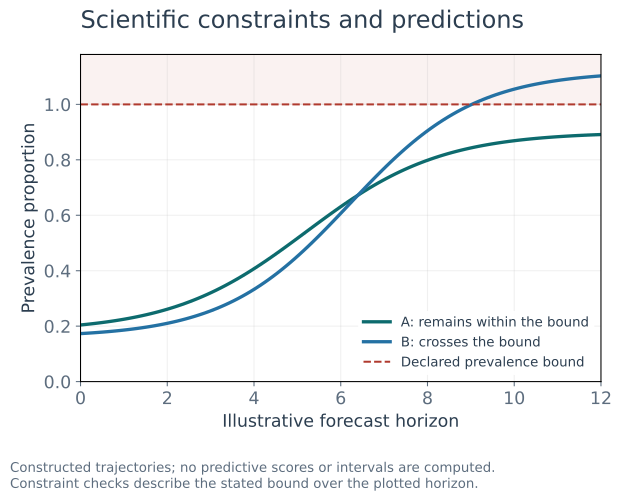
I have been developing checks that report whether a scientific prediction satisfies stated constraints without using the outcome it is intended to predict. Observations already available when the prediction is made may still inform a check. A forecast of a proportion, for example, should lie between zero and one.
The work examines how to report constraint compliance alongside predictive accuracy, with explicit assumptions and limits. It distinguishes constraints satisfied by construction from those observed to hold for a particular prediction. Compliance alone does not establish predictive accuracy. Rather than a standalone method, this is now being folded into the validation layer of the software stack.
Vector PDF · All figure sources and downloads
Inference and calibration
op_infer connects fitting tools, simulation-based checks and replicated studies for incomplete or noisy observations. Its status is Public; package maturity: pre-alpha; unreleased on PyPI (0.0.1 development)
while its scientific applications are assessed. Application data and partner materials remain private.
Scientific machine learning and incomplete data
I am studying representations of dynamical systems that satisfy selected scientific constraints by construction. The work asks what sparse measurements can reveal about a trajectory and which assumptions are needed to recover scientific quantities from incomplete observations. Questions about reconstruction accuracy, stability and uncertainty remain part of this ongoing work.
A related thread asks how many underlying patterns can be distinguished from noise in an incomplete dataset. The released VBPCApy software provides Bayesian dimensionality reduction; pp-eigentest is ongoing research on signal-rank selection, building on a 2024 preprint.
Application studies
Dengue within-host dynamics. Current work develops inference and model assessment for viral and immune responses across successive infections and their relationship to antibody-dependent enhancement. It builds on an earlier preprint.
COVID-19 observation noise. Controlled simulation studies examine how assumptions about surveillance error affect inferred dynamics, predictive uncertainty, and forecast assessment.
Diphtheria outbreak vaccination. Ongoing modeling compares the timing and effects of response strategies under uncertain transmission and immunity.
Crimean-Congo hemorrhagic fever surveillance and control. Modeling across hosts and scales investigates which wildlife and livestock measurements inform disease risk and control choices, alongside their field costs.
Working repositories remain private while the analyses mature. Public artifacts will be added as they are released. See operational modeling for a separate account of my contributions to ongoing forecasting and policy-support programs.